By clicking the submit button below, I hereby agree to and accept Telgorithm’s terms and conditions.

“How much does 10DLC SMS cost?” is one of the most common—and most misunderstood—questions in A2P messaging.
The confusion usually comes from one thing: 10DLC SMS pricing is not a single line item.
Instead, the total cost of 10DLC messaging is made up of several components that work together—some set by your API provider, some mandated by mobile carriers, and some required by industry regulators.
This guide breaks down every cost that contributes to the true price of 10DLC messaging, including a commonly overlooked factor: the cost of failed messages caused by poor throughput management.
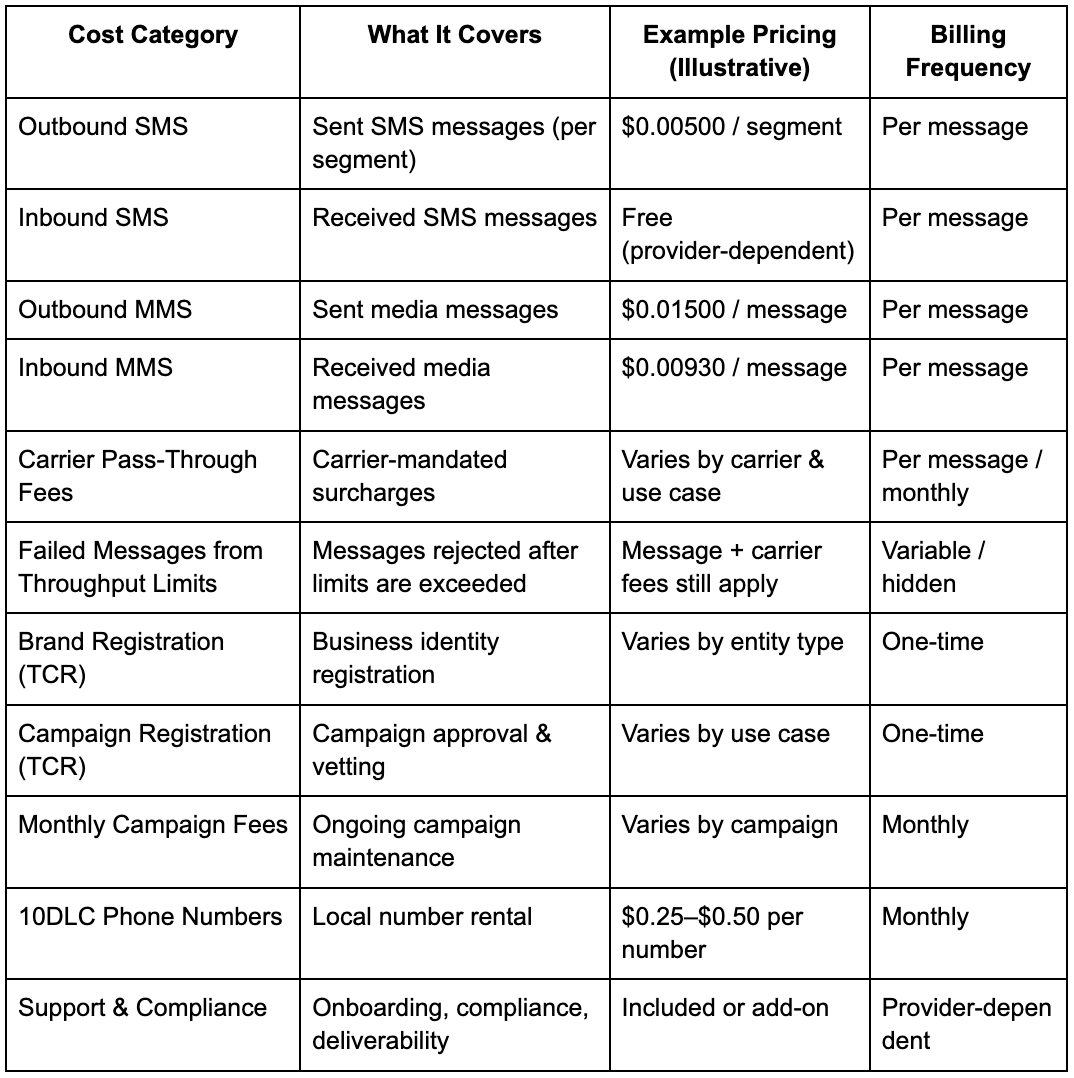
At a high level, the cost of 10DLC messaging includes:
Let’s walk through each component in detail.
Your API provider will charge for sending (and sometimes receiving) SMS and MMS messages. These charges are typically billed per message or per segment.
MMS messages are billed per message and support media like images, GIFs, or videos.
Using Telgorithm’s base pricing as an example, messaging costs may look like:
SMS and MMS pricing does not include carrier pass-through fees, which apply separately.
Inbound pricing varies widely by provider. Some charge for inbound messages, while others include them at no cost.
Carrier pass-through fees are mandatory charges set by mobile carriers (such as AT&T, T-Mobile, and Verizon, and their subsidiaries). These fees are required for 10DLC traffic to be delivered and are passed through by your provider.
Key things to know:
Carrier fees may include:
Carrier fees may include message-based surcharges, monthly Campaign fees, or carrier-specific compliance charges.
Because these fees apply regardless of provider, it’s critical to distinguish API provider pricing from carrier-mandated costs when evaluating total spend.
Beyond visible line items like messaging rates and carrier fees, there’s another cost factor that often goes unaccounted for:
The cost of failed messages caused by poor throughput management.
Each carrier enforces its own throughput limits, but T-Mobile’s strict daily and per-campaign limits are where many senders encounter issues. When these limits are exceeded, messages can fail—and importantly, failed messages are often still billable.
That means platforms may still pay:
If a provider doesn’t proactively manage throughput at the Brand, Campaign, phone number, and carrier level, messages may be sent faster than carriers allow. Without real-time awareness of where each message is headed—and how close the sender is to approved limits—exceeding carrier thresholds becomes likely.
To handle carrier limits without true throughput management, many providers default to one of two approaches:
Neither approach fully solves the problem of balancing delivery speed, compliance, and cost.
Over time, poor throughput management can lead to:
In other words, throughput management directly impacts the true cost of 10DLC messaging, even though it rarely appears as a line item on a pricing page.
All A2P 10DLC messaging requires registration with The Campaign Registry (TCR).
Registration costs are separate from messaging fees and typically include:
These costs vary based on:
Because registration pricing has multiple variables, we don’t repeat it in full here.
For a complete breakdown by use case, read our guide on the cost of 10LC registration.
10DLC messaging uses standard 10-digit long code (local) phone numbers. These numbers are billed monthly and are separate from messaging and registration costs.
Phone number pricing often scales with volume.
Phone number costs are usually modest compared to messaging volume, but they can add up for platforms managing large pools of numbers.
This is one of the biggest differentiators between providers.
Some API providers charge extra for:
Others include these services as part of the platform.
Understanding whether support is included or monetized separately is important when calculating your true total cost of ownership.
Below is a consolidated view of the typical cost components involved in 10DLC messaging.
It’s tempting to compare providers based on the lowest SMS rate—but that often tells only part of the story.
Poor throughput management, failed messages, non-compliant traffic, or unclear carrier fees can lead to:
In many cases, how messages are managed and delivered matters just as much as how much each message costs.
10DLC SMS pricing isn’t complicated, but it is multi-layered.
Understanding each cost component allows you to:
If you’re planning to send A2P SMS at scale, transparency across messaging, carrier fees, registration, phone numbers, and support is essential.
Reach out to one of our 10DLC experts to learn more.
Receive updates from our team including latest industry news, upcoming webinars, 10DLC tips & more.
By clicking the submit button below, I hereby agree to and accept Telgorithm’s terms and conditions.