By clicking the submit button below, I hereby agree to and accept Telgorithm’s terms and conditions.
Carrier pass-through fees are a small line item that can have a big impact on the total cost of A2P messaging at scale.
So far in 2026, all three major U.S. wireless carriers (T-Mobile, AT&T, and Verizon) have raised at least one A2P messaging fee. Across four pricing updates in under nine months, six individual SMS and MMS fee increases took effect.
For software platforms and ISVs trying to understand how 10DLC costs are changing, here's what has increased so far this year and what those changes add up to.
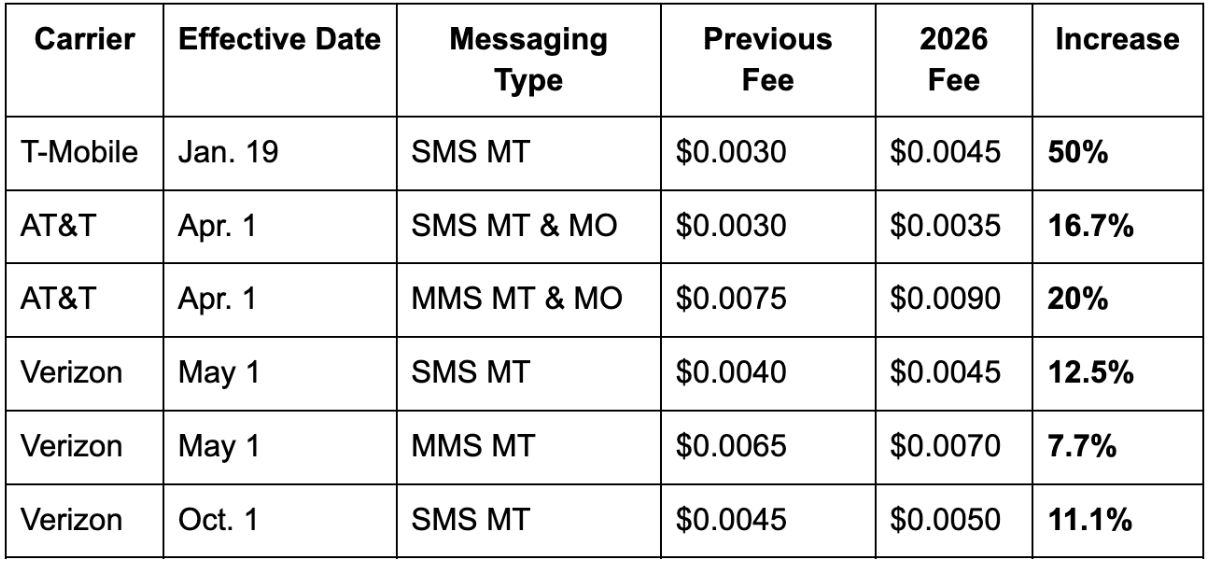
Rates shown are for registered 10DLC traffic as of October 2026. MT = mobile terminated (outbound); MO = mobile originated (inbound). SMS fees are charged per message segment, so a message that splits into two segments incurs the fee twice.
T-Mobile kicked off the year with the largest percentage increase shown here: its outbound SMS fee rose from $0.0030 to $0.0045 per message on January 19, a 50% increase. At the same time, T-Mobile lowered its inbound 10DLC SMS fee from $0.0030 to $0.0025. That's a modest offset for platforms with heavy two-way traffic.
AT&T followed on April 1, increasing both inbound and outbound SMS fees by approximately 16.7% and MMS fees by 20%.
Verizon raised outbound SMS and MMS fees on May 1, then raised its outbound SMS fee again on October 1. That puts Verizon's SMS MT rate at $0.0050 per segment, up from $0.0040 at the start of the year, a 25% cumulative increase in 2026.
Fractions of a cent can be easy to dismiss. For platforms processing millions of messages, they're anything but.
Start with Verizon. A platform sending 1 million outbound SMS segments to Verizon subscribers would have paid $4,000 in carrier fees at the $0.0040 rate in effect before May. At the $0.0050 rate in effect since October 1, the same volume costs $5,000, a $1,000 difference per million segments.
The picture gets clearer across all three carriers. Assuming outbound SMS traffic is split evenly across T-Mobile, AT&T, and Verizon, the blended carrier fee rose from roughly $0.0033 per segment at the start of the year to roughly $0.0043 today, an increase of about 30%. For a platform sending 10 million outbound SMS segments a month, that's about $10,000 more in carrier fees every month, or roughly $120,000 a year, before MMS. Actual impact will vary with each platform's subscriber mix.
And carrier fees are only one component of the total cost of 10DLC messaging. Platforms also need to account for messaging provider rates, phone numbers, registration and Campaign fees, and the operational cost of messages that fail or need to be retried. Our 2026 A2P 10DLC Messaging Cost Benchmark breaks down these components in more detail.
All three major carriers raised fees in the same year, and Verizon did it twice in five months.
These increases weren't limited to 10DLC, either. T-Mobile, AT&T, and Verizon applied their 2026 SMS changes across 10DLC, Toll-Free, and Short Code traffic, and Verizon's October update raised its RCS Rich MT fee alongside SMS. Switching number types doesn't avoid these costs.
Nor is this a one-year anomaly. In 2024, T-Mobile raised its unregistered 10DLC SMS fee by 50%, from $0.008 to $0.012. The direction of carrier pricing has been consistent: up.
Carrier pass-through fees are set by the mobile carriers and passed through the messaging ecosystem, meaning players like Direct Connect Aggregators (DCAs) or API providers don't control these increases. For high-volume ISVs, that makes carrier pricing an increasingly important variable when forecasting the true cost of messaging.
It also makes delivery efficiency more important. As the cost attached to each message rises, failed messages, unnecessary retries, and inefficient traffic management become more expensive too. A message that's dropped and reattempted can mean paying the carrier fee more than once for a single delivered message.
Carrier fees will continue to be one piece of the broader A2P messaging cost equation.
For platforms operating at scale, the goal isn't simply to find the lowest advertised API rate. It's to understand the total cost of sending and successfully delivering a message, including provider rates, pass-through fees, compliance costs, and delivery performance.
At Telgorithm, we track pricing changes as they're announced and help ISVs understand how those changes affect their messaging costs. Our patented Smart Queueing technology also proactively manages carrier throughput limits to help prevent avoidable message failures and the costs associated with them.
Want to take a closer look at your 10DLC costs? Talk to Telgorithm about your messaging volume, carrier fees, and delivery performance.
Receive updates from our team including latest industry news, upcoming webinars, 10DLC tips & more.
By clicking the submit button below, I hereby agree to and accept Telgorithm’s terms and conditions.