By clicking the submit button below, I hereby agree to and accept Telgorithm’s terms and conditions.

RCS Business Messaging introduces richer content, verified business identities, interactive experiences, and new ways for businesses and customers to communicate. But for software platforms evaluating RCS, there’s another practical question to answer:
How much does RCS actually cost?
The short answer is that there isn’t one universal RCS rate.
Like A2P 10DLC, the total cost of RCS Business Messaging extends beyond the rate your messaging provider charges to send a message. RCS costs can include compliance and onboarding fees, carrier pass-through fees, and provider messaging fees. Depending on the type of RCS traffic, you may also be paying per message or for an entire 24-hour conversation.
For Independent Software Vendors (ISVs) and platforms already familiar with 10DLC, parts of this model will look surprisingly familiar. Other parts require a new way of thinking about messaging costs.
Here’s how RCS pricing breaks down.
At a high level, RCS Business Messaging costs fall into three layers:
Total RCS Cost = Compliance Fees + Carrier Fees + Provider Fees
The distinction matters because not every part of your RCS bill is controlled by your messaging provider.
Compliance fees are third-party costs associated with registering, vetting, and verifying RCS messaging programs. Carrier fees are set by mobile network operators and vary based on the carrier and type of RCS traffic. Provider fees are the rates and service costs set by the messaging provider you choose.
If you already send A2P 10DLC SMS or MMS, the overall structure of RCS pricing shouldn't be completely unfamiliar.
With both channels, businesses encounter costs beyond simply transmitting a message. Registration and compliance processes introduce non-negotiable third-party fees, carriers assess pass-through fees on messaging traffic, and messaging providers charge for access to their platforms, APIs, and services.
But the specifics differ.
RCS introduces its own Verified Sender and Campaign verification costs, carrier rates vary across multiple RCS message types, and qualifying two-way interactions can use a session-based pricing model that doesn't exist in 10DLC.
Here's a simplified comparison:
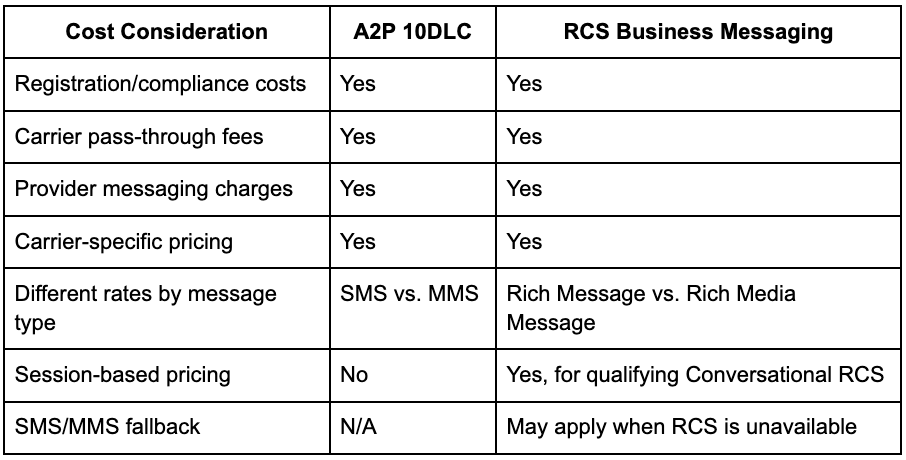
The takeaway isn't that RCS pricing works exactly like 10DLC. Rather, the same principle applies: the provider's messaging rate is only one component of the total cost.
Before RCS traffic can be sent, businesses and their messaging programs go through onboarding and verification processes within the RCS ecosystem.
Those processes carry their own fees.
Current third-party fees include:
Additional fees may apply depending on the carrier. T-Mobile, for example, currently assesses:
These are separate from the price of sending RCS traffic and are paid to the respective third parties rather than being determined by the messaging provider.
Again, there's a useful parallel to 10DLC: business messaging compliance has a cost of its own. Registration, identity verification, and Campaign onboarding should be accounted for separately from ongoing messaging volume when estimating the cost of launching a new channel.
Once traffic starts flowing, carriers assess their own fees.
Just as U.S. carriers set pass-through fees for A2P 10DLC SMS and MMS, they also establish rates for RCS Business Messaging. These fees are non-negotiable, can change over time, and are passed through by messaging providers.
Unlike a simple "RCS message rate," however, the amount can depend on which carrier receives the traffic and what kind of RCS message is being exchanged.
Current example carrier fees include:
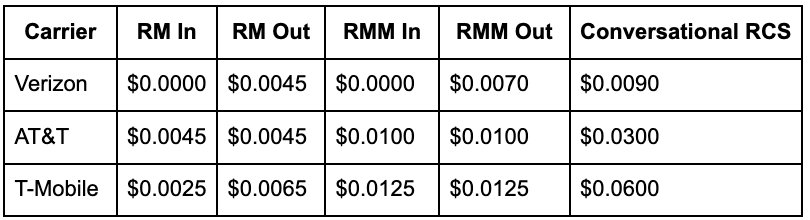
RM = Rich Message; RMM = Rich Media Message. Rates shown are examples as of Summer 2026 and are subject to change.
This is one reason modeling RCS costs requires more than multiplying total message volume by one rate. Carrier distribution matters.
A program whose customers are distributed across Verizon, AT&T, and T-Mobile will incur a mix of carrier fees rather than one universal pass-through rate.
The third layer is the portion controlled by your messaging provider.
Provider fees cover the use of the provider's messaging infrastructure, API, and services. Unlike carrier and third-party compliance fees, these rates can vary from provider to provider.
For example, Telgorithm's base RCS pricing includes:
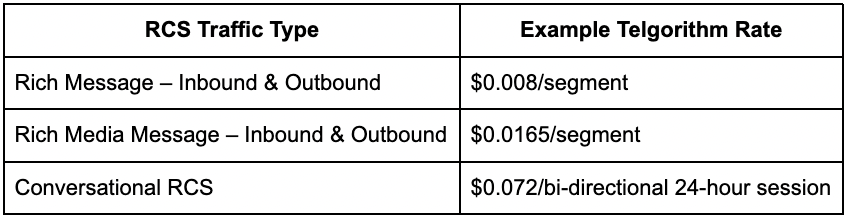
If two providers are subject to the same third-party compliance and carrier fees, those costs shouldn't be treated as meaningful provider differentiators. Instead, compare the provider-controlled portion of the bill and what you're receiving for it.
That includes not only messaging rates, but also platform fees, professional services, compliance guidance, fallback capabilities, throughput management, support, and other services that may either be included or billed separately.
Not every RCS message costs the same amount.
A Rich Message (RM) and Rich Media Message (RMM) are different message types and carry different provider and carrier rates.
That makes the content of an RCS program part of its cost model.
A program primarily sending text-based Rich Messages, for example, won't necessarily have the same cost profile as one heavily using richer media experiences.
For platforms building RCS into their products, estimating volume alone therefore isn't enough. It's also useful to estimate the mix of RCS message types your customers are likely to send.
Here's where RCS pricing begins to diverge more significantly from traditional A2P SMS and MMS.
10DLC messaging is fundamentally message-based: costs scale based on the SMS or MMS traffic being sent and received.
RCS can introduce another billing unit: the conversation.
Under Telgorithm's Conversational RCS model, qualifying two-way interactions can be billed as a 24-hour bi-directional session rather than charging the provider rate for every individual RCS segment exchanged during that session. Telgorithm's example provider rate is $0.072 per qualifying session, before applicable carrier fees.
If the Conversational RCS billing trigger isn't met, the traffic is instead charged per segment.
That distinction becomes particularly important for use cases involving ongoing customer interaction, such as support conversations, guided flows, surveys, and AI assistants.
For a deeper look at how a session qualifies and how message volume affects the economics, see our guide to What Is Conversational RCS? How Session-Based RCS Pricing Works.
This is where the three layers come together.
Suppose an RCS program sends 100,000 outbound Rich Messages per month.
Using Telgorithm's example provider rate, the provider messaging portion would be:
100,000 × $0.008 = $800
But $800 is not the total cost of that RCS traffic.
Applicable carrier pass-through fees would still need to be added. Those depend on the recipients' carriers.
For example, the current outbound Rich Message carrier fee ranges from $0.0045 on Verizon and AT&T to $0.0065 on T-Mobile.
If the 100,000 messages were distributed approximately evenly across the three carriers, the carrier portion would be roughly:
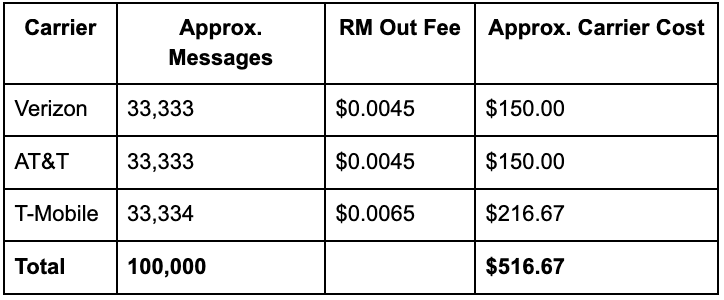
That would put the estimated recurring messaging cost at approximately:
$800 provider messaging fees + $516.67 carrier fees = $1,316.67
or approximately $0.0132 per outbound Rich Message under this hypothetical carrier mix.
Any applicable onboarding, verification, fallback, or other costs would still need to be considered separately.
This example is simplified, but it shows how three inputs — provider rate, message volume, and carrier mix — combine to produce an actual delivered cost.
For platforms evaluating RCS, a better question is often:
What will it cost to support this particular customer experience on RCS, and what happens when RCS isn't available?
That's where SMS enters the equation again.
RCS availability isn't universal for every recipient or every messaging scenario, making SMS/MMS fallback an important part of both the delivery strategy and the cost model.
Telgorithm includes automatic AI-powered SMS fallback functionality with its RCS messaging services at no additional charge. However, when a message falls back to SMS or MMS, the applicable SMS/MMS messaging rates still apply.
In other words:
Fallback functionality may be included, but fallback traffic isn't free.
For ISVs, that means forecasting an RCS program may require modeling both channels rather than treating RCS as a completely separate replacement for SMS.
The percentage of traffic that reaches customers over RCS versus falls back to SMS/MMS can affect the program's ultimate cost.
When evaluating RCS providers, don't stop at "What's your price per message?"
Instead, look at the entire cost structure.
Ask which fees are third-party pass-through costs and which are provider-controlled. Determine whether there are additional platform, onboarding, implementation, professional services, or support fees. Understand how Rich Messages, Rich Media Messages, and conversational traffic are billed. And find out how SMS fallback and throughput are handled.
At Telgorithm, RCS messaging services include capabilities such as automatic AI-powered SMS fallback, patented Smart Queueing, enterprise-grade support, and compliance guidance without additional charges for those services.
The goal is to understand not just the lowest rate on a pricing sheet, but what it will actually cost to reliably operate RCS at scale.
RCS pricing is new, but the economics of business messaging aren't.
Like 10DLC, the true cost extends beyond a provider's base messaging rate. Compliance and onboarding fees, carrier pass-through charges, provider rates, message types, traffic patterns, and fallback can all contribute to the final bill.
RCS adds another dimension through richer message types and Conversational RCS, making it especially important to model the customer experience rather than simply estimating a number of messages.
For ISVs evaluating RCS, start by separating the costs that are largely fixed across the ecosystem from those controlled by the provider.
Then ask the more important question:
What are we getting for the portion of the cost we can actually choose?
Receive updates from our team including latest industry news, upcoming webinars, 10DLC tips & more.
By clicking the submit button below, I hereby agree to and accept Telgorithm’s terms and conditions.