By clicking the submit button below, I hereby agree to and accept Telgorithm’s terms and conditions.
RCS Business Messaging introduces much more than richer messages. It also creates new ways for businesses to think about the economics of customer conversations.
One of those models is Conversational RCS: a session-based billing model designed for interactive, two-way exchanges between a business and its customers.
Instead of paying for every individual Rich Message or Rich Media Message exchanged, qualifying traffic can be billed as a conversation session. Once that session begins, the business and customer can continue exchanging messages within the 24-hour conversation window without each additional message generating another RCS messaging charge.
Telgorithm is one of the first messaging providers to offer Conversational RCS pricing, and because the model is still relatively new, we want to break down exactly what it means, how a conversation is triggered, and when session-based pricing can change the economics of RCS.
This distinction is important.
Conversational RCS uses the same RCS Business Messaging experience as other RCS traffic. Businesses can still communicate through a verified RCS agent and use features such as rich media, cards, suggested replies, interactive actions, file sharing, and location sharing.
What's different is how qualifying traffic is billed.
Standard RCS traffic is generally categorized as either a Rich Message or Rich Media Message, with charges associated with those messages. Conversational RCS shifts qualifying two-way interactions to a session-based model instead.
That means businesses don't have to choose between "sending an RCS message" and "sending a Conversational RCS message." A conversation becomes conversational when the exchange meets the applicable criteria.
For an interaction to trigger a Conversational RCS session, the conversation must include at least four Rich or Rich Media Messages exchanged between the business and the end user.
Within those messages, there must be:
Qualifying MO events can include:
In other words, the model is intended for a genuine two-way interaction—not simply a sequence of outbound notifications from a business.
Imagine a customer starts an RCS support interaction:
Brand → Customer: How can we help with your order today?
Customer → Brand: I need to change my delivery address.
Brand → Customer: No problem. Is this for order #12345?
Customer → Brand: Yes.
That exchange has now included four messages, at least one brand-to-user message, and two genuine user-to-brand messages.
The interaction therefore meets the criteria for a Conversational RCS session.
From there, the conversation can continue within the active 24-hour session without every additional Rich or Rich Media Message creating another messaging charge.
The more interactive an RCS experience becomes, the more important the billing model can become.
Consider a simple one-way notification. A business sends an appointment reminder, the customer reads it, and the interaction ends. Per-message pricing is relatively straightforward.
Now consider a support conversation.
A customer asks a question. The business responds. The customer provides more information. The business asks a follow-up question. The customer selects an option. The business confirms the change.
Suddenly, one customer interaction can involve many individual messages.
With traditional per-message pricing, the more messages sent, the higher the overall cost (including carrier pass-through fees). With Conversational RCS, qualifying traffic is instead billed around the session.
That can make costs more predictable for use cases intentionally designed around back-and-forth engagement.
One of the biggest advantages of Conversational RCS is that the cost of a qualifying interaction is based on the 24-hour session—not the number of individual Rich or Rich Media Messages exchanged within it.
To see what that can look like at scale, let's model a few scenarios using Telgorithm's current Conversational RCS pricing.
Telgorithm charges $0.072 per 24-hour Conversational RCS session, inclusive of Rich and Rich Media Messages exchanged within the session. Carrier fees are passed through separately and vary by carrier.
Within a qualifying session, the carrier also bills a single conversational session fee—not a per-message fee. So because both the Telgorithm session rate and the carrier fee are charged per session, additional messages inside the 24-hour window don't increase either cost.
For the examples below, we'll assume traffic is distributed evenly across Verizon, AT&T, and T-Mobile:
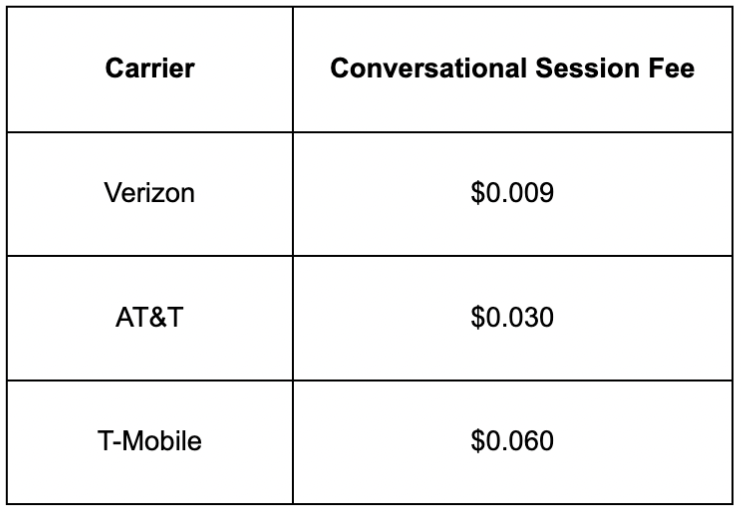
Blended Carrier Cost = $0.033
That gives us an estimated combined cost of:
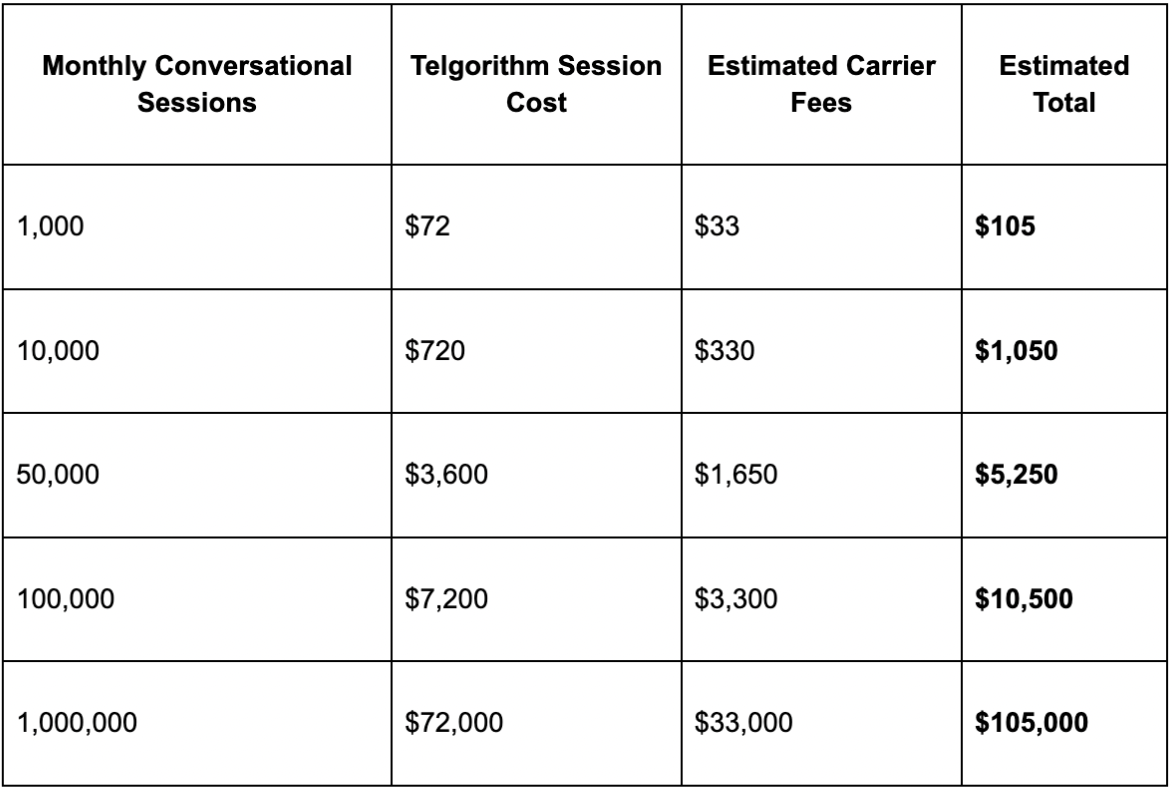
$0.072 Telgorithm session rate + $0.033 blended carrier fees = $0.105 per 24-hour session
Using that assumption, the cost scales predictably with the number of conversations:
The number of sessions is only half of the story.
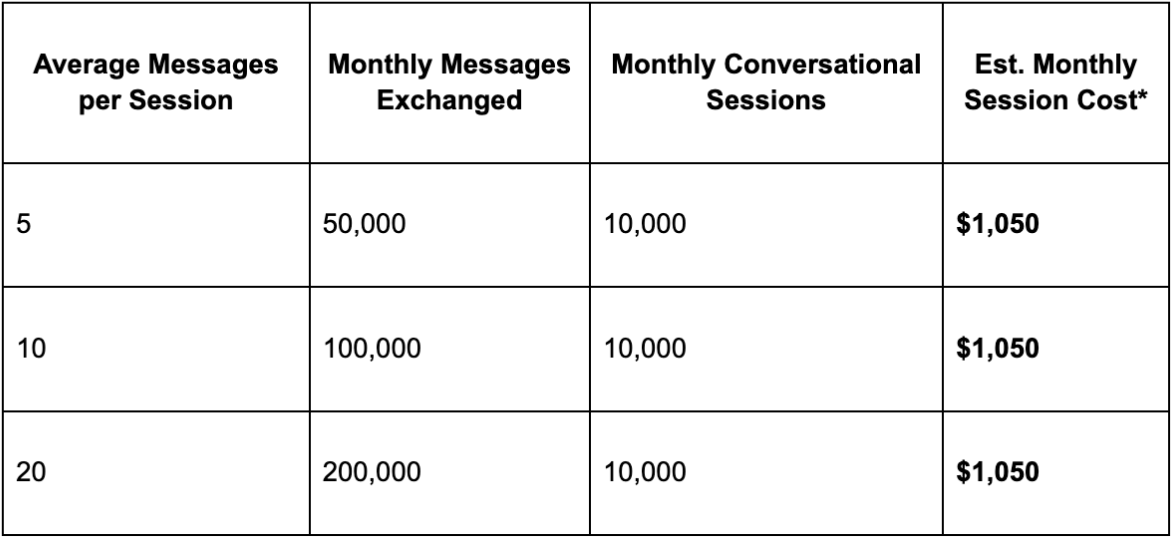
Suppose a business averages 10,000 qualifying Conversational RCS sessions per month. The number of individual messages exchanged within those sessions can vary significantly.
At five messages per session, that's approximately 50,000 messages exchanged per month. At 10 messages, it's 100,000. At 20 messages, it's 200,000.
But because all three scenarios still represent 10,000 qualifying 24-hour sessions, the estimated monthly Conversational RCS cost remains $1,050.
That's the fundamental economic difference.
Conversational RCS becomes most valuable exactly where conversations get longest—and nothing generates more back-and-forth than AI.
Conversations with a live human agent benefit from session-based pricing, but a person typically resolves an issue in a handful of messages, and those exchanges often stretch across hours or days as people step away and come back. AI and agentic assistants are different on both counts. They respond instantly, so an entire interaction usually completes inside a single 24-hour window. And they're inherently high-turn: a capable assistant asks clarifying questions, presents options as cards or quick replies, confirms details, and follows up—often a dozen or more messages to fully resolve a single request.
Under per-message pricing, that richness works against you. Every turn the assistant takes adds cost, which quietly pressures teams to cut conversations short or strip out the interactive elements that make RCS valuable in the first place. Under Conversational RCS, the entire exchange is billed as one session no matter how many messages it takes. As the example above showed, a 20-message conversation costs exactly the same as a 5-message one once it qualifies as a session.
That's why agentic use cases—automated customer support, guided product selection, troubleshooting, onboarding flows, and AI-driven assistants—are where session-based pricing has the most impact. The more autonomous and conversational the experience, the more messages it generates, and the more a per-message model would have penalized it.
Conversational RCS lets businesses build AI interactions around actually resolving the customer's need, rather than around minimizing the number of replies.
With per-message RCS pricing, the cost of an interaction generally increases as more messages are exchanged. With Conversational RCS, once an interaction qualifies as a session, the number of Rich and Rich Media Messages exchanged within that 24-hour window does not increase the session charge.
For businesses building truly interactive experiences, that can make the cost of RCS significantly more predictable as conversations become longer and more engaging.
*These examples are illustrative estimates based on Telgorithm's Conversational RCS provider rate of $0.072 per 24-hour session and the carrier fees available as of Summer 2026. For simplicity, the models assume an even one-third distribution of sessions across Verizon, AT&T, and T-Mobile, resulting in an estimated blended carrier fee of $0.033 per session. Actual costs will vary based on carrier distribution, current carrier rates, session volume, traffic patterns, and other applicable fees. SMS/MMS fallback traffic is billed separately at the applicable SMS/MMS rates.
Unlimited messaging within a session doesn't mean businesses should design unnecessarily long customer journeys.
The goal is to remove the pressure to optimize a conversation around the cost of every individual response.
If resolving a customer's problem naturally takes eight exchanges instead of four, the business can focus on creating a better experience rather than asking whether another response materially increases messaging costs.
That's especially relevant for use cases such as live customer support, guided product selection, troubleshooting, appointment scheduling, surveys, customer onboarding, and automated assistants.
RCS still isn't universally available across every customer, device, carrier, messaging application, and network condition.
That's why fallback remains an important part of an RCS strategy.
Telgorithm can automatically fall back to an appropriately registered SMS or MMS campaign when RCS cannot be delivered, helping businesses maintain reach rather than simply ending the interaction.
However, fallback traffic follows the pricing of the fallback channel.
SMS and MMS messages are billed according to their applicable messaging, carrier, and registration costs; they are not included in the Conversational RCS session price.
That distinction should be included when modeling the total cost of an RCS deployment.
For decades, business messaging economics have largely centered on message volume: send another message, incur another messaging charge.
Conversational RCS introduces another option.
For the right use case, businesses can begin thinking in terms of the cost of a customer conversation rather than simply the cost of an individual message.
That doesn't make Conversational RCS the right billing model for every RCS interaction. Simple notifications and primarily one-way campaigns may still fit naturally within Rich or Rich Media Message pricing.
But when the goal is genuine back-and-forth engagement, session-based pricing can give businesses more room to build useful, interactive customer experiences without costs increasing with every turn of the conversation.
As one of the first messaging providers to offer Conversational RCS, Telgorithm is helping ISVs understand not only how to deploy RCS Business Messaging, but how to choose the billing and messaging approach that makes sense for their customer journeys.
Learn more about Conversational RCS Business Messaging or explore our RCS API documentation to see how RCS works within the Telgorithm platform.
Receive updates from our team including latest industry news, upcoming webinars, 10DLC tips & more.
By clicking the submit button below, I hereby agree to and accept Telgorithm’s terms and conditions.