By clicking the submit button below, I hereby agree to and accept Telgorithm’s terms and conditions.
Verizon has announced another increase to its A2P messaging pass-through fees, effective October 1, 2026.
The update will raise Verizon's mobile terminated (MT), or outbound, messaging, fee for SMS from $0.0045 to $0.0050 per message, applying across 10DLC, Toll-Free, and Short Code traffic. Verizon's RCS Rich MT fee will also increase from $0.0045 to $0.0050.
Verizon does not charge a carrier pass-through fee for mobile originated (MO), or inbound, messages, and that will remain unchanged. MMS pricing and the $500 Standard-Rated Short Code migration fee will also remain unchanged.
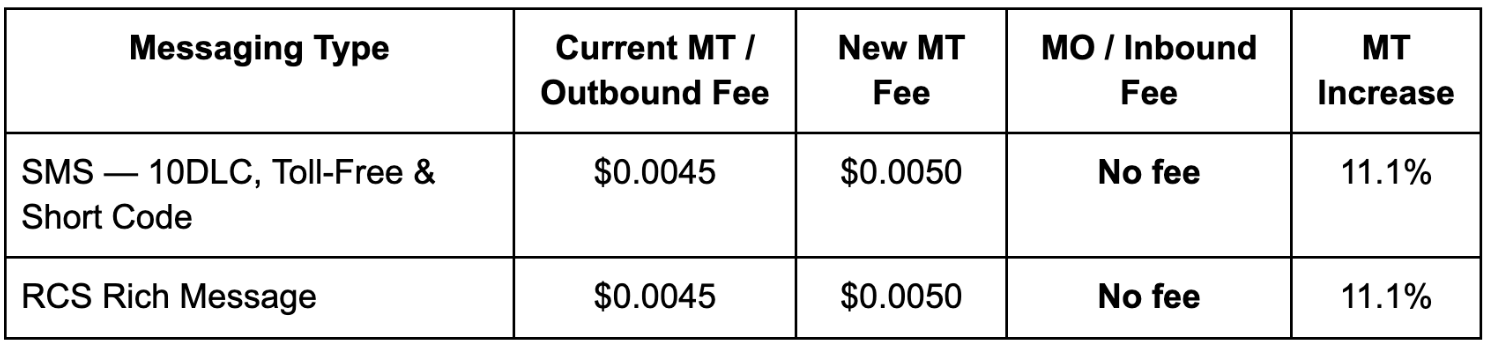
The increase amounts to an additional $0.0005 per outbound message, or approximately $500 in additional carrier fees for every 1 million applicable messages sent to Verizon subscribers.
This update comes just months after Verizon's last A2P pricing change.
On May 1, 2026, Verizon increased its MT SMS fee to $0.0045 across 10DLC, Toll-Free, and Short Code messaging. That update also increased MMS fees and raised the Standard-Rated Short Code migration fee from $150 to $500.
That makes this October 1 increase Verizon's second increase to its outbound SMS pass-through fee in just five months.
Another notable part of this announcement is the inclusion of RCS Business Messaging.
Verizon's RCS Rich Message MT fee will move alongside SMS, increasing from $0.0045 to $0.0050 per message.
As RCS adoption continues to grow, pricing updates like this are another reason for software platforms to understand the full cost structure behind each messaging channel—not only provider pricing, but carrier fees, message type, fallback traffic, and the billing model associated with the RCS traffic they send.
A $0.0005 increase can look small on a per-message basis. At scale, it isn't.
For ISVs and software platforms processing millions of messages, carrier pass-through fees represent a meaningful portion of total messaging spend—and those costs continue to change independently of the rates charged by messaging API providers.
This is also why evaluating messaging costs based on a provider's advertised per-message rate alone can be misleading. Carrier pass-through fees are separate costs, and increases like Verizon's are passed through across the messaging ecosystem.
Platforms should account for these changes when forecasting messaging spend and evaluating the true cost of their SMS and RCS traffic.
For software platforms operating at scale, carrier fee changes can add up quickly. Keeping track of these updates—and understanding how they affect the total cost of each messaging channel—is an increasingly important part of managing messaging spend.
We'll continue tracking carrier pricing changes and breaking down what they mean as new updates are announced.
Receive updates from our team including latest industry news, upcoming webinars, 10DLC tips & more.
By clicking the submit button below, I hereby agree to and accept Telgorithm’s terms and conditions.