By clicking the submit button below, I hereby agree to and accept Telgorithm’s terms and conditions.
As RCS Business Messaging becomes more widely available, businesses and software platforms have a new messaging channel to evaluate: how does RCS compare to A2P 10DLC, and how does it compare to SMS?
While SMS is the underlying messaging technology, A2P 10DLC refers specifically to the U.S. framework for sending business SMS and MMS through registered local phone numbers. That's why comparisons between RCS and SMS often overlap with comparisons between RCS and 10DLC.
Both channels reach consumers on their mobile phones, but they differ in messaging experience, registration, pricing, and reach. It also isn't necessarily an either/or decision. RCS offers a richer, branded experience when it's available, while SMS and MMS provide broad reach and the fallback path that RCS depends on.
Here's how the two compare.
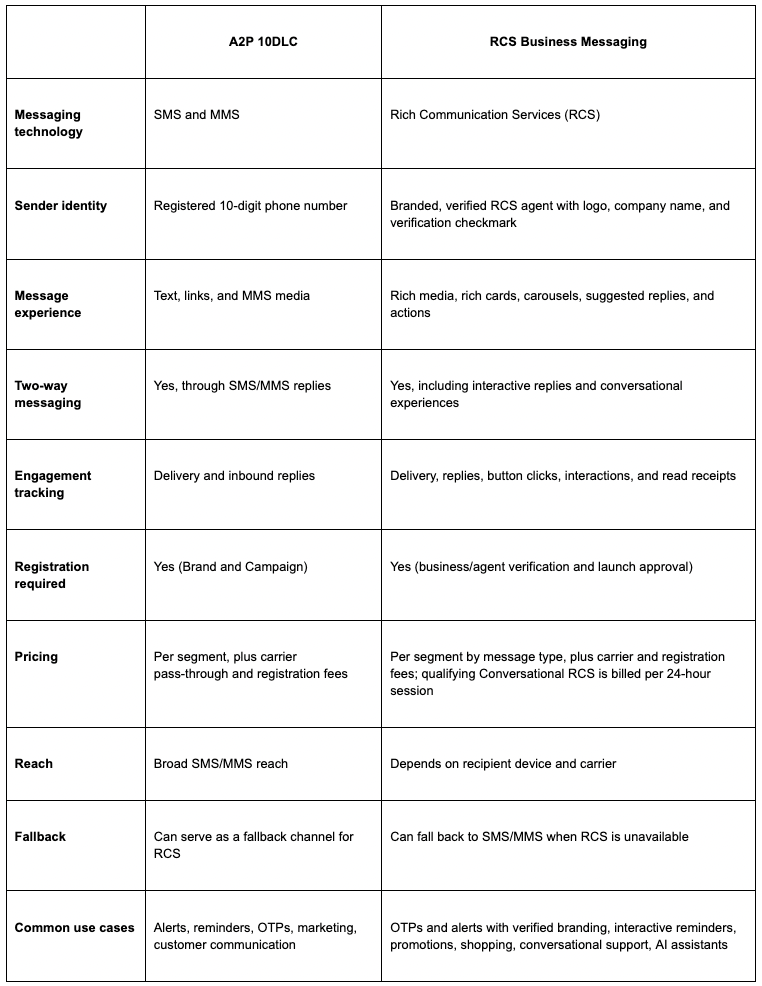
The biggest difference is the experience each channel delivers. Reach, registration, and cost also shape how each fits into a messaging strategy.
A2P 10DLC is the framework for sending application-to-person SMS and MMS over standard 10-digit local phone numbers in the United States. Businesses register their identity and messaging use case before sending traffic. For software platforms and Campaign Service Providers (CSPs), that means managing Brand and Campaign registration, phone number assignment, opt-in and consent, and throughput and carrier requirements.
Once registered, businesses reach consumers with familiar SMS and MMS across nearly every mobile device. For a full walkthrough, see our A2P 10DLC Guide.
RCS Business Messaging (RBM) takes mobile messaging beyond SMS and MMS. Instead of a phone number alone, businesses message consumers through a branded, verified RCS agent that displays their logo, company name, and a verification checkmark.
RCS comes in two message types:
Conversational RCS isn't a third message type. It's a billing model for qualifying two-way conversations made of Rich and Rich Media Messages (more on that in the pricing section).
A2P 10DLC delivers text and links over SMS and media such as images over MMS. Consumers can reply directly, so it works for both one-way notifications and two-way conversations. Appointment reminders, account alerts, delivery updates, OTPs, and marketing promotions often need nothing more.
RCS adds an app-like layer inside the consumer's native messaging app. Recipients can tap to reply, open a URL, dial, share a location, or add a calendar event without leaving the conversation. Businesses can also track button clicks, interactions, and read receipts.
RCS use cases span both simple and interactive messaging:
Notice the overlap: simple notifications can run on either channel. The question isn't which channel has more features. It's whether RCS branding and interactivity add value to the interaction you're building.
Both channels require registration and verification before a business can message consumers. The workflows differ, but the principle is the same: verified identities, legitimate use cases, and compliant consumer experiences.
10DLC registration centers on Brands and Campaigns. A business registers a Brand for its identity and one or more Campaigns for its use cases. Campaigns include sample messages, opt-in processes, Terms and Conditions, and Privacy Policies. Once approved, phone numbers are associated with the Campaign.
RCS registration has its own onboarding, including Verified Sender vetting of the business and its brand assets (such as its logo and banner) and Campaign verification. Much of the Brand information will feel familiar to businesses that have already registered for 10DLC.
Neither channel is "register once and forget." Requirements evolve, registrations need accurate information, and consent rules still apply. For ISVs managing messaging for many downstream customers, compliance stays an ongoing operational task on both channels.
The two pricing models share several cost components, but can bill usage differently. On both channels, the total cost has three layers: third-party registration and compliance fees, carrier pass-through fees, and provider fees. Both also bill messages by the segment, so a longer message can span more than one billable segment.
The differences come down to two things:
One more cost to model: RCS fallback traffic isn't free. When a message falls back to SMS or MMS, it's billed at the fallback channel's standard rates (such as 10DLC) plus carrier fees, not at RCS or session rates.
That's why comparing one SMS rate to one RCS rate rarely tells the full story. It's more useful to compare the cost of a specific customer interaction, from a one-message alert to a 20-message support conversation.
For the full numbers, see:
Not currently, and this is one of the most important differences between the channels. SMS is supported on virtually every mobile phone. RCS depends on whether the recipient’s device and carrier support it, and even then delivery over RCS isn’t guaranteed for every message.
Yes, when SMS/MMS fallback is configured. If a recipient can't receive RCS, the messaging platform can route an alternative version of the message through a registered 10DLC or Toll-Free number. This creates a dependency worth planning for: RCS enhances the experience, while SMS and MMS preserve reach.
That dependency means a strong fallback starts with a strong SMS foundation. If fallback numbers aren't properly registered, or throughput isn't managed, fallback traffic can be blocked or fail. An interactive RCS message with cards and buttons also doesn't translate directly into a single SMS, so the fallback version needs to preserve the message's intent.
At Telgorithm, RCS includes real-time device detection and automatic, AI-powered fallback that reformats the message into a compliant SMS that stays as close to the RCS experience as possible. Patented Smart Queueing manages fallback traffic against carrier rate limits. For more, see RCS (RBM) Doesn't Replace SMS—It Depends on It.
No single channel is right for every interaction. Take an appointment reminder. If the goal is simply "Your appointment is tomorrow at 2 PM," an SMS may do everything the business needs. If the business wants the customer to confirm, reschedule, or chat with an assistant, an RCS experience can add value. And if it wants that richer experience without losing customers who can't receive RCS, the two channels work together.
A2P 10DLC may make sense when:
RCS may make sense when:
Using both may make sense when:
For software platforms, the long-term question is less about choosing one channel and more about routing each interaction through the channel that fits the use case and the recipient.
A2P 10DLC and RCS Business Messaging are more complementary than competitive. 10DLC brings the reach and familiarity of SMS and MMS; RCS brings branded, interactive experiences; and fallback connects the two. The goal doesn't necessarily have to be replacing an existing SMS program, but identifying where each channel does the job best.
Telgorithm supports A2P messaging across 10DLC, Toll-Free, and RCS Business Messaging, helping software platforms manage registration, compliance, and delivery across channels. Learn more about RCS Business Messaging with Telgorithm.
A2P 10DLC sends SMS and MMS over registered 10-digit local phone numbers. RCS Business Messaging sends branded, verified messages with rich media and interactive features such as cards, suggested replies, and actions.
No. RCS introduces capabilities beyond traditional SMS and MMS, but those channels remain important for broad reach and fallback. Businesses can use both technologies as part of a unified messaging strategy.
Yes. RCS has its own onboarding, including business/agent verification and launch approval, separate from 10DLC Brand and Campaign registration. Both involve third-party fees.
No. RCS and 10DLC have separate registration processes, and you can register for RCS without a 10DLC fallback number. However, we recommend proactively enabling SMS/MMS fallback over a registered 10DLC or Toll-Free number to protect your reach and deliverability.
It depends on the interaction. Both are billed per segment plus carrier and registration fees, though RCS rates differ by message type. Qualifying Conversational RCS traffic is billed per 24-hour session, and fallback traffic is billed at SMS/MMS rates.
Yes. A business can use RCS for branded or interactive messages where it's available, and SMS/MMS for other use cases and fallback.
Receive updates from our team including latest industry news, upcoming webinars, 10DLC tips & more.
By clicking the submit button below, I hereby agree to and accept Telgorithm’s terms and conditions.